
Suzuki Violin Book 7 PDF: A Comprehensive Guide
Suzuki Violin School, Volume 7 is a crucial resource for progressing students, readily available as a PDF for convenient access and study.
Finding a legitimate PDF copy requires careful consideration of legal and ethical sourcing, ensuring respect for copyright regulations.
What is the Suzuki Violin School?
The Suzuki Violin School, developed by Shinichi Suzuki, is a globally recognized music education method emphasizing learning music similarly to acquiring a native language. This approach, often called the “Mother Tongue” method, prioritizes listening and imitation before formal instruction.
The school consists of ten volumes, each introducing progressively challenging pieces. Volume 7 represents a significant step for violinists, building upon foundational skills. It’s integral to Suzuki lessons, featuring revised editing of pieces, including bowings and fingerings, and additional exercises.
The method stresses parental involvement and the crucial role of a qualified teacher. Accessing materials like Suzuki Violin Book 7, often sought in PDF format, is a key component of this learning journey, though legal sourcing is paramount.
The Importance of Volume 7
Suzuki Violin Book 7 marks a pivotal stage in a student’s development, demanding increased technical proficiency and musical maturity. It bridges the gap between intermediate and advanced playing, introducing more complex pieces and refined techniques. This volume solidifies skills like shifting, vibrato, and intonation, preparing students for challenging repertoire.
The revised edition offers updated bowings and fingerings, enhancing the learning experience. Access to a PDF version allows for convenient practice and study, but obtaining it legally is essential. Mastering Volume 7 builds confidence and lays a strong foundation for tackling the subsequent books.
It’s an integral part of Suzuki lessons, fostering a deeper understanding of musical expression and artistry.
Availability of Suzuki Violin Book 7 PDF
Finding a Suzuki Violin Book 7 PDF can be challenging, as official digital versions aren’t always readily available for free. While some websites may offer downloads, verifying their legitimacy is crucial to avoid copyright infringement. Purchasing a digital copy through authorized retailers like Alfred Music or Sheet Music Plus is the safest option.
Unofficial sources may contain inaccurate transcriptions or incomplete content. Amazon also offers the book, potentially with a digital version. Remember to prioritize legal and ethical access to support the composer and publisher. A legitimate PDF ensures quality and accuracy for effective learning.
Legal Considerations for PDF Downloads
Downloading a Suzuki Violin Book 7 PDF from unauthorized sources carries significant legal risks. Copyright law protects Shinichi Suzuki’s work, and distributing or obtaining copies illegally is a violation. This can result in penalties for both the uploader and downloader.
Always purchase the PDF from reputable vendors like Alfred Music, Sheet Music Plus, or Amazon to ensure compliance. Supporting official channels safeguards the rights of the composer and publisher. Respecting copyright fosters a sustainable environment for musical education and encourages continued creation of valuable resources like the Suzuki method.

Content Overview of Suzuki Violin Book 7
Suzuki Violin School, Volume 7 features revised pieces, new exercises, and updated bowings/fingerings, building upon prior skills for advanced violinists.
Pieces Included in Volume 7
Suzuki Violin School, Volume 7 presents a carefully curated selection of pieces designed to challenge and inspire advanced violin students. This volume builds upon the foundation established in previous books, introducing more complex musical concepts and demanding greater technical proficiency. The repertoire includes works by composers such as Bach, Handel, and Seitz, offering a diverse range of styles and periods.
Specifically, students will encounter pieces that focus on developing advanced techniques like shifting, vibrato, and refined intonation. The revised edition incorporates updated editing of these pieces, including suggested bowings and fingerings to aid in interpretation and execution. This volume isn’t just about playing notes; it’s about musical expression and artistry, preparing students for a wider range of repertoire.
Technical Skills Developed
Suzuki Violin School, Volume 7 significantly advances technical capabilities. Students will refine shifting exercises, seamlessly navigating positions on the fingerboard with accuracy and speed. Vibrato development takes center stage, fostering a rich and expressive tone. Precise intonation refinement is paramount, demanding attentive listening and accurate finger placement.
Furthermore, the volume incorporates scales and arpeggios, building finger dexterity and reinforcing theoretical understanding. The revised edition’s bowings and fingerings encourage efficient technique. Mastering these skills isn’t merely about technical prowess; it’s about unlocking musicality and enabling students to tackle increasingly challenging repertoire with confidence and artistry.
Musical Styles Explored
Suzuki Violin School, Volume 7 broadens the student’s musical horizons, venturing beyond earlier styles. While rooted in the classical tradition, the repertoire introduces nuances of Baroque and early Classical periods. Students encounter pieces demanding stylistic awareness, fostering interpretive skills beyond technical execution.
The selection encourages a deeper understanding of phrasing, articulation, and dynamic contrast appropriate to each composer’s era. Exposure to diverse musical languages cultivates a more versatile and expressive violinist. This volume isn’t just about playing notes; it’s about embodying the spirit and character of different musical styles, enriching the overall musical experience.
Bowings and Fingerings in the Revised Edition
Suzuki Violin School, Volume 7’s revised edition presents significant improvements in bowing and fingering suggestions. These updates, meticulously crafted, aim to enhance playability and musicality for students. The revisions address challenges encountered in earlier editions, offering more efficient and expressive solutions.
Shinichi Suzuki’s original insights are integrated with contemporary pedagogical approaches. Expect clearer indications for shifts, string crossings, and vibrato application. These detailed markings guide students toward refined technique and a more polished performance. The revised edition isn’t merely a collection of notes; it’s a thoughtfully annotated guide to masterful violin playing.

Finding Official Suzuki Recordings
Suzuki Book 7 benefits greatly from accompanying recordings, though locating official versions can be challenging; updated download links are available online for easy access.
Importance of Listening to Recordings
Listening to the official Suzuki recordings is absolutely essential for students working through Book 7, and indeed, the entire Suzuki method. Shinichi Suzuki’s philosophy centers around learning by ear, mirroring how children acquire their native language – hence the “mother tongue” approach.
These recordings provide a model for intonation, phrasing, and stylistic interpretation that goes beyond simply reading the notes on the page. Students internalize the correct sound, developing a more refined musical ear.
Hearing a professional performance allows students to understand the musicality of each piece, inspiring them and providing a clear goal for their own practice. It’s not merely about technical accuracy, but about achieving a beautiful and expressive sound, which the recordings demonstrate perfectly.
Where to Download Suzuki Book 7 Recordings
Locating official Suzuki Book 7 recordings can be surprisingly challenging, despite their importance. While a comprehensive, centralized source doesn’t exist, several avenues offer access. Digital music stores like iTunes and Amazon Music often carry individual tracks or complete albums.
Dedicated websites compiling links to Suzuki recordings are invaluable resources, though links can become outdated. The Suzuki Association of the Americas may offer guidance or resources on their website.
Be cautious of unofficial sources, as audio quality and accuracy can vary significantly. Prioritize purchasing from reputable platforms to support the creators and ensure a high-quality listening experience for optimal learning.

Updated Links for Audio Resources
Finding current links for Suzuki Book 7 audio requires diligent searching, as websites frequently update or remove content; Several online resources attempt to curate these links, but verification is crucial. Regularly check forums dedicated to the Suzuki method, as members often share working links and discuss availability.
Consider exploring streaming services; some may offer Suzuki recordings through subscription models. Always prioritize official sources to ensure accurate interpretations and high audio quality. Beware of unauthorized uploads, which may infringe on copyright and offer substandard sound.
Remember to double-check links before relying on them!
Challenges in Locating Official Recordings
Locating official Suzuki Book 7 recordings presents several hurdles for students and teachers alike. The distribution landscape is fragmented, with recordings not always readily available on major streaming platforms. Older recordings may be out of print or difficult to find in physical formats.
Copyright restrictions and licensing agreements further complicate access. Many unofficial uploads exist, but these often lack quality control or proper authorization. The absence of a centralized, official digital store for all Suzuki recordings contributes to the difficulty.
Persistent searching and community resources are often necessary.

Purchasing Options for Suzuki Violin Book 7
Suzuki Violin School, Volume 7 is available for purchase from Amazon, Alfred Music, and Sheet Music Plus, as well as select local music retailers.
Amazon Availability
Amazon.com consistently offers Suzuki Violin School, Vol 7: Violin Part, typically in both physical book format and, occasionally, as a digital download. As of today, March 26, 2026, the book is readily available with a listed price, though this can fluctuate based on seller and condition.
Customers frequently highlight that this Suzuki book is integral to their violin lessons. The revised edition features updated bowings and fingerings, alongside supplementary exercises directly from Shinichi Suzuki himself. Amazon provides customer reviews, offering valuable insights into the book’s quality and usefulness for students at this level.
Be sure to check shipping options and potential availability of used copies for cost savings. Prime members often benefit from free and expedited shipping.
Alfred Music Website
Alfred Music, the official publisher of the Suzuki Violin School, directly sells Volume 7 through their website. This ensures you’re acquiring an authentic and legally sourced copy, avoiding potential issues with unauthorized PDFs. The website typically offers both the physical book and digital download options, though availability may vary.
Like Amazon, Alfred Music emphasizes that this book is integral for Suzuki violin lessons. The revised edition boasts meticulously updated editing of pieces, including refined bowings and fingerings.
Furthermore, it includes additional exercises, some originating directly from Shinichi Suzuki, enhancing the learning experience. Check for promotional offers or bundled packages that may include accompanying recordings.
Sheet Music Plus
Sheet Music Plus is a prominent online retailer offering Suzuki Violin School, Volume 7, providing both physical copies and digital downloads, including PDF versions. They frequently feature competitive pricing and various shipping options, making it a convenient choice for many musicians.
While they sell the core Suzuki material, always verify the edition and ensure it aligns with your teacher’s requirements. Like other vendors, Sheet Music Plus highlights the book’s importance for structured Suzuki lessons.
The revised edition includes updated bowings, fingerings, and supplementary exercises from Shinichi Suzuki himself, enriching the student’s technical and musical development.
Local Music Stores
Supporting local music stores remains a valuable option for acquiring Suzuki Violin School, Volume 7, even in the digital age. These stores often stock physical copies and can sometimes assist with ordering the book or providing information about PDF availability through authorized distributors.
The benefit of a local store lies in personalized service; staff can offer advice, answer questions, and potentially connect you with qualified Suzuki teachers in your area. They may also carry supplementary materials.
While a direct PDF download might not always be available in-store, they can guide you towards legitimate online sources.

Supplementary Repertoire for Books 6, 7 & 8
Suzuki students benefit from expanding beyond core materials; the Suzuki Association of the Americas offers suggested pieces to enrich learning.
Exploring diverse composers complements Volume 7 studies.
Expanding Beyond the Core Curriculum
Suzuki Violin School, Volume 7 provides a strong foundation, but supplementing with additional repertoire significantly enhances a student’s musical development. This expansion fosters creativity, broadens technical skills, and cultivates a deeper appreciation for diverse musical styles.
Moving beyond the prescribed pieces allows students to explore different eras and composers, solidifying their understanding of musical phrasing and interpretation. The Suzuki Association of the Americas actively promotes this approach, offering curated lists of suitable supplementary works.
These resources provide a pathway to challenge students appropriately, building confidence and musicality. Integrating varied pieces alongside the core Suzuki material creates a well-rounded and enriching learning experience, preparing students for future musical endeavors.
Recommended Composers and Pieces
For students progressing through Suzuki Violin School, Volume 7, expanding repertoire with composers like Bach, Handel, and Vivaldi is highly beneficial. Their sonatas and concertos offer excellent technical challenges and musical depth.
Consider pieces such as Bach’s Minuet in G Major (BWV Anh. 114) or Handel’s Sonata in D Major, Op. 6 No. 12. These selections complement the Suzuki curriculum, reinforcing skills developed in Volume 7. Exploring works by Seitz and Wohlfahrt also provides valuable practice material.
The Suzuki Association of the Americas provides further suggestions, ensuring appropriate difficulty and musicality. Supplementing with these composers enriches the learning experience and fosters a broader musical understanding.
Resources from the Suzuki Association of the Americas
The Suzuki Association of the Americas (SAA) is an invaluable resource for students and teachers utilizing the Suzuki Violin School, including Volume 7. Their website offers a wealth of materials, supporting a comprehensive learning experience.
The SAA provides access to teacher directories, workshops, and events focused on the Suzuki method. They also curate supplementary repertoire lists, specifically tailored for books 6, 7, and 8, enhancing musical development.
Furthermore, the SAA offers guidance on finding qualified teachers and understanding the core principles of the Suzuki philosophy. Exploring their resources ensures a well-rounded and enriching musical journey.
Benefits of Supplementary Repertoire
Expanding beyond the core Suzuki Violin School, Volume 7 curriculum with supplementary repertoire offers significant benefits for developing violinists. It fosters musicality, enhances technical skills, and broadens stylistic understanding.
Introducing diverse composers and pieces cultivates a more comprehensive musical foundation, preventing stagnation and encouraging artistic expression. Supplementary materials can address specific technical challenges, reinforcing concepts learned in Volume 7.
This approach also increases student engagement and motivation, making practice more enjoyable and rewarding. Carefully selected repertoire complements the Suzuki method, accelerating progress and nurturing a lifelong love of music.

Understanding the Suzuki Method
Shinichi Suzuki’s innovative “mother tongue” approach emphasizes learning through listening and imitation, a cornerstone of the Suzuki Violin School, including Book 7.
Shinichi Suzuki’s Philosophy
Shinichi Suzuki believed that musical ability, like language, is best developed early in life through immersion and a nurturing environment. He observed that children readily acquire their native language without formal instruction, simply by being surrounded by it. This inspired his method, aiming to cultivate musical talent similarly.
Suzuki posited that every child possesses the potential to learn, given the right conditions. He emphasized the importance of a supportive relationship between student, teacher, and parent. His philosophy wasn’t about innate talent, but about creating an environment where potential could flourish.
This approach, central to the Suzuki Violin School – and therefore relevant to Book 7 – prioritizes listening, repetition, and positive reinforcement. The goal isn’t just technical proficiency, but the development of a beautiful tone and a love for music.
The “Mother Tongue” Approach
The “Mother Tongue” approach, foundational to the Suzuki Violin School – including Book 7 – mirrors language acquisition. Just as children learn to speak by constant listening before attempting to vocalize, Suzuki students immerse themselves in music before playing. Repeated listening to recordings is paramount.
This method emphasizes creating a musical environment. Students aren’t initially focused on reading music; instead, they absorb the sound and internalize the musicality. This builds a strong foundation of aural skills and musical understanding.
The idea is that the violin becomes a “second language,” learned naturally through consistent exposure and imitation. This approach fosters a deeper connection to the music, moving beyond technical execution to genuine expression, crucial even at the level of Book 7.
Parental Involvement
Parental involvement is a cornerstone of the Suzuki method, extending through all levels, including diligent study of Suzuki Violin Book 7. Parents aren’t merely logistical supporters; they are active participants in their child’s musical journey.
This includes daily listening to the assigned pieces – vital for internalizing the music – and attending lessons to take detailed notes. Parents reinforce practice at home, creating a supportive and encouraging environment.
They also serve as a bridge between the teacher and the student, ensuring consistent progress. At Book 7’s advanced level, parental support remains crucial for motivation and overcoming challenges, fostering a lifelong love of music.
The Role of the Teacher
The Suzuki teacher acts as a guide, mentor, and facilitator in the student’s progression through Suzuki Violin Book 7 and beyond. Their role extends far beyond simply imparting technical skills; they cultivate a nurturing learning environment.
A skilled teacher carefully assesses each student’s individual needs, tailoring instruction to maximize their potential. They provide insightful feedback, address technical challenges, and inspire musical expression.
Furthermore, the teacher fosters a sense of community among students, encouraging collaboration and mutual support. With Book 7’s demanding repertoire, the teacher’s expertise is paramount in navigating complexities and ensuring a positive learning experience.

Technical Exercises in Book 7
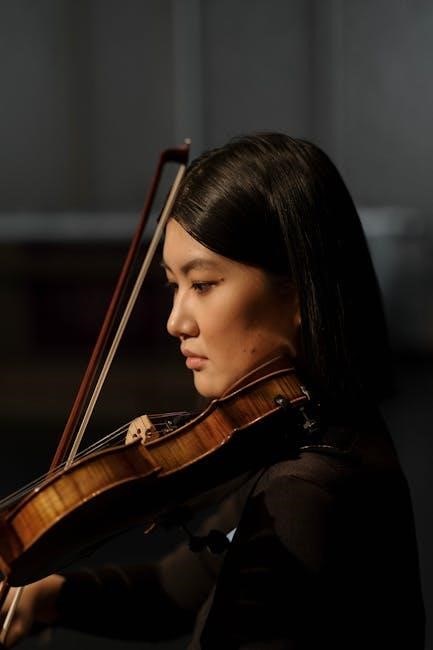
Suzuki Violin Book 7 incorporates challenging scales, arpeggios, shifting, and vibrato exercises to refine technique and build a strong foundation for advanced playing.
Scales and Arpeggios
Suzuki Violin Book 7 significantly expands upon scale and arpeggio work from previous volumes, demanding increased precision and fluency. Students encounter more complex key signatures and patterns, solidifying their understanding of music theory in practical application.
The exercises aren’t merely rote practice; they are designed to develop intonation, left-hand dexterity, and bow control. Focus shifts towards achieving a consistently beautiful tone across the entire range of the instrument.
These exercises prepare students for the technical demands of the repertoire included in the book, and lay the groundwork for tackling even more challenging pieces in the future. Mastering these foundational elements is paramount for continued progress.
Shifting Exercises
Suzuki Violin Book 7 introduces more sophisticated shifting exercises, building upon the foundational skills established in earlier volumes. Students begin to navigate positions with greater confidence and accuracy, essential for mastering the repertoire.
These exercises focus on smooth, seamless transitions between positions, minimizing audible breaks and maintaining a consistent tone quality. Emphasis is placed on developing a secure left-hand frame and anticipating the next position.
The book incorporates exercises that challenge students to shift across multiple strings and in various rhythmic patterns, enhancing their overall technical proficiency. Precise intonation during shifts is a key objective, fostering musicality.
Vibrato Development
Suzuki Violin Book 7 marks a significant stage in vibrato development, moving beyond initial exploration to focused refinement. Students begin to integrate vibrato into their playing with greater control and musicality, enhancing expressive capabilities.
Exercises concentrate on establishing a relaxed wrist motion as the foundation for a natural, resonant vibrato. The book guides students through various vibrato speeds and widths, adapting to the character of each piece.
Emphasis is placed on applying vibrato selectively, using it to highlight important notes and phrases. Developing a consistent and beautiful vibrato requires dedicated practice and mindful attention to sound quality.
Intonation Refinement

Suzuki Violin Book 7 presents increasingly complex passages demanding precise intonation. Students encounter challenging key signatures and shifting positions, requiring heightened ear training and finger accuracy.
The repertoire necessitates careful listening and self-assessment to identify and correct intonation tendencies. Exercises focus on developing a strong internal sense of pitch and the ability to adjust finger placement in real-time.
Teachers emphasize the importance of slow, deliberate practice with a tuner or drone to build a solid foundation. Mastering intonation at this level is crucial for achieving a polished and professional sound.